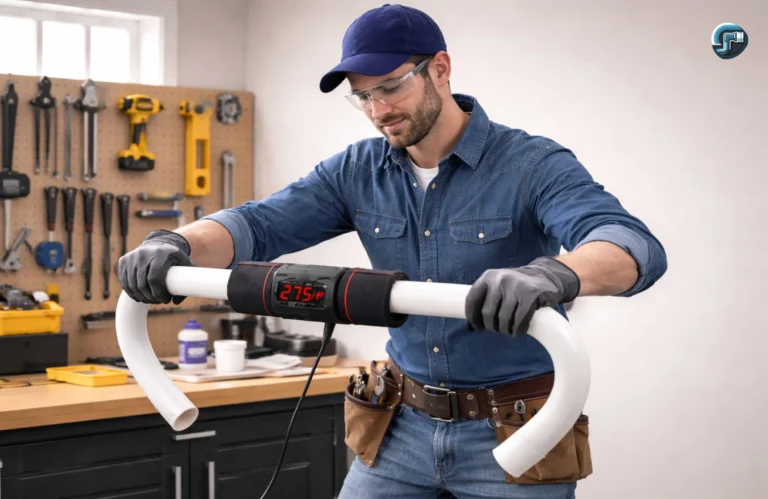
How to Measure PVC Pipe?

People who visit their local hardware store plumbing aisle experience the same problem which occurs when they bring home a 1-inch PVC fitting that fails to fit their 1-inch pipe. One of the most common frustrations in DIY plumbing and construction is realising that a pipe’s name does not always match its physical dimensions. The correct method for measuring PVC pipe provides time savings and prevents hardware store return trips while ensuring your project maintains its ability to hold water without leaks. The question is how to measure PVC pipe? This complete guide provides all the methods which professionals employ to measure pipes.
You will learn the difference between nominal and actual sizes, discover the best pipe measurement tools to use, and get clear step-by-step instructions on finding the correct dimensions for any project.
We will look forward to the difference between nominal and actual sizes of common PVC pipe sizes and find the best pipe measurement tools which give clear step by step instructions on finding the right dimensions for any project.
The Mystery of PVC Pipe Sizing
Before you pull out a ruler, you need to see how manufacturers classify plastic plumbing materials. The most important concept to grasp is the difference between “nominal” size and actual size.
The PVC standard pipe sizes system means that a 1-inch PVC pipe does not actually measure one inch in its internal or external diameter. Instead, the 1-inch label refers to a nominal size, which is an industry standard used to ensure compatibility with fittings and other plumbing components.
Plastic Pipe Sizes are based on the inner hollow area, which carries the water. However, depending on the pipe’s wall thickness, the actual inner space can vary slightly.
Schedule 40 vs. Schedule 80
The wall thickness of a plastic pipe is referred to as its “Schedule.” You will most often encounter two main types:
Schedule 40: Usually white, this is the standard pipe used for home plumbing and residential irrigation. It has thinner walls.
Schedule 80 pipes usually have dark grey colour. It has thicker walls to handle much higher pressure. Schedule 40 and 80 pipes have the same outer diameter and they can be used as the same standard 1-inch pipe fitting. This shows us that both can be used on 1-inch pipe fitting. The schedule 80 pipe has thicker walls, its inner diameter is smaller.
Essential Pipe Measurement Tools
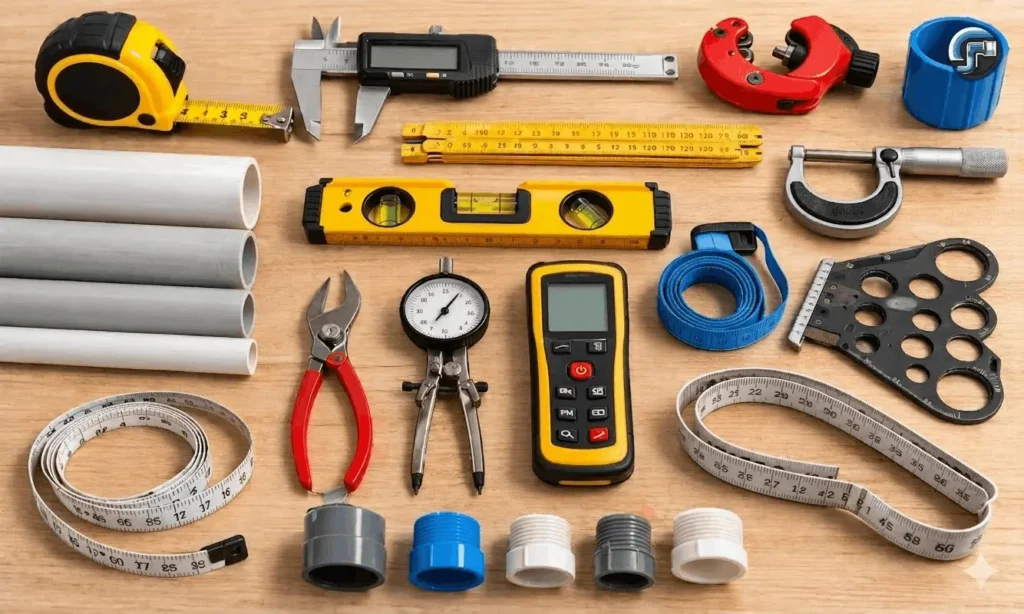
Accuracy requires the right equipment. While you might be tempted to eyeball it with a standard school ruler, upgrading your toolkit will yield much better results. Here are the best pipe measurement tools to keep in your garage:
Digital Calipers: This is the absolute best tool for the job. The calipers measure pipe dimensions through their capability to either slice through the pipe or wrap around its circumference to deliver decimal measurements in both inches and millimetres. Flexible Measuring Tape A cloth measuring tape like the kind used by tailors is perfect for wrapping around a pipe to find its circumference.
String and a Tape Measure: If you lack a flexible measuring tape, you can wrap a piece of string around the pipe, mark it, and lay it flat against a standard metal tape measure.
Pi Tape: Professionals often use a special Pi tape. You wrap it around the pipe, and the tape automatically converts the circumference into the pipe diameter.
How do you measure PVC Pipe?
The people involved in a project will ask about proper PVC pipe measurement methods when the project experiences difficulties. The three main dimensions that you can measure include outer diameter (OD) and inner diameter (ID) and outer circumference.
Here is how to find each measurement accurately.
Method 1: Finding the Outer Diameter (OD)
Measuring the outer diameter is the most reliable way to figure out what standard pipe size you have, because the outer dimension remains constant regardless of the pipe’s schedule.
Take your digital calipers and open the jaws.
Slide the jaws around the smooth, un-cut exterior of the pipe. Do not measure near a flared end or a bell joint.
Close the jaws snugly against the pipe’s walls.
Read the measurement.
If your actual outer diameter measures 1.315 inches, you are holding a nominal 1-inch pipe. If the outer diameter reads 1.050 inches, it is a 3/4-inch nominal pipe. You can easily find conversion charts online that map the exact outer diameter to the standard nominal size.
Method 2: Measuring the Inner Diameter (ID)
If you are trying to calculate flow rate or determine the schedule of an unlabeled pipe, you need the inner diameter.
Make sure the end of the pipe is cut perfectly straight and clean. A jagged cut will skew your results.
Use the top, upward-facing jaws of your digital calipers (designed for inner measurements).
Insert them into the pipe opening and expand them until they touch the inner walls. Record the measurement.
Method 3: Using Pipe Circumference
Sometimes a pipe is already installed against a wall, or it is too large for your calipers. In these cases, you need to know how to measure a plastic pipe using its circumference. Take a flexible measuring tape or a piece of string.
Wrap it tightly around the outside of the pipe. Make sure it goes straight around, not at a diagonal angle.
Pinch the string where it meets the starting end and measure that length against a standard ruler. This gives you your pipe circumference.
Divide that circumference by Pi (3.14159) to find the outer pipe diameter.
Once you have that outer diameter, you simply match it to a standard pipe conversion chart to find the nominal size.
Finding the Right Pipe Fitting
A common mistake DIYers make is measuring the inside of a pipe fitting. The measurement stamped on a standard fitting indicates the nominal size of the pipe it is meant to accept.
For example, a standard 2-inch elbow joint is designed to slide perfectly over the outside of a 2-inch nominal pipe. If you measure the inside diameter of that elbow, it will measure roughly 2.375 inches—which exactly matches the outer diameter of a 2-inch pipe.
When buying fittings, always shop by the nominal pipe size you determined using the outer diameter method above. Do not try to match actual measurements to actual measurements when pairing a pipe and a fitting, or you will end up with components that are too loose to glue together.
Tips for Measuring Installed Pipes
It’s easy to measure the length of a PVC pipe when it’s loose on a workbench. But what happens when you need to tap into an existing water line in your basement or under your yard? The first step requires you to check all printed labels. Manufacturers stamp the nominal size, the schedule, and the material (PVC, CPVC, ABS) directly onto the side of the plastic. You can avoid all measuring requirements because damp rags will remove all dirt and dust from surfaces.
If the labels have worn off, use the string method to find the circumference. People find it easier to use thin string for this task because existing pipes are usually installed flush against walls or buried in tight trenches.
The last step requires you to observe the color. Standard white plastic is almost always Schedule 40 PVC. CPVC piping appears cream-colored or off-white because it uses a different sizing system called Copper Tube Size (CTS). The material identification enables you to select the proper conversion chart.
FAQ’s
Conclusion
To master the PVC pipe measurement you just need to master the sizes of pipes. You don’t need to take a ruler for measurement. When you consider the outer diameter you just divert the confusion of wall thicknesses and you’re pretty sure that you’re buying the right materials.